
The Subconscious Mind: What It Actually Controls, and How Hypnotherapy Helps You Change It
Why willpower alone can't rewrite old patterns, and what actually can.
Most of us walk around assuming we're driving the car. We decide what to eat, how to react, who to trust, what we're capable of. But the truth is that the conscious mind, the part of you reading this sentence right now, is only running a small fraction of the show. The rest is being handled by something quieter, older, and far more powerful: your subconscious mind.
If you've ever wondered why you keep repeating a pattern you know isn't good for you, why your body panics before your brain even catches up, or why "just think positive" has never actually worked, the subconscious is where the real answer lives.
What Is the Subconscious Mind?
The subconscious mind isn't a separate brain or a mystical concept. It's everything happening below the surface of conscious awareness: the store of every memory, belief, and learned association you've ever picked up, especially the ones formed early in life or reinforced through repetition. It doesn't reason the way your conscious mind does. It doesn't weigh pros and cons. It runs on pattern and association, this reminds me of that, so I'll respond the way I always have.
Think of your conscious mind as the part of you making decisions in the moment, and your subconscious as the operating system running quietly in the background, the one actually calling most of the shots.
What the Subconscious Actually Controls
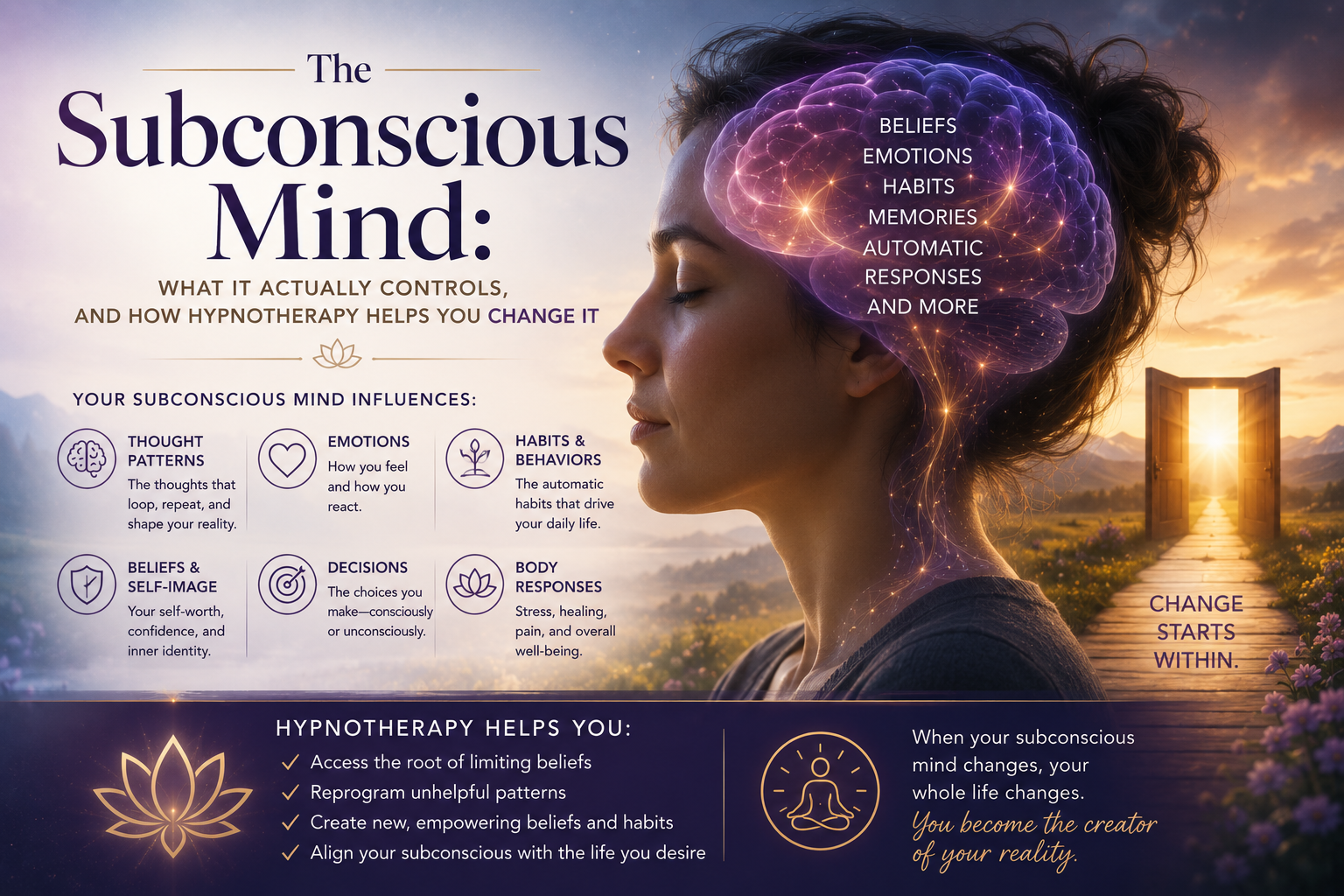
Far more than people realize. It runs the habits you do without thinking, from the route you drive to work to the way you respond when someone raises their voice. It holds your emotional triggers, the reactions that show up instantly and intensely before you've had a chance to think them through. It stores your core beliefs about your own worth, safety, and capability, often laid down years before you had the ability to question them. It regulates your body's stress response, the racing heart, the shallow breath, the tight chest, through the autonomic nervous system, largely outside conscious control. And it holds the long-running patterns you keep bumping into around money, relationships, or self-image, the ones that feel like "just who you are" even when you'd like them to be different.
Why Willpower Alone Doesn't Change These Patterns
This is where so many people get stuck. You can know, intellectually, that you're capable, that you're safe, that a relationship isn't good for you, and still feel none of it. That gap between knowing and feeling is the gap between your conscious mind and your subconscious. Willpower operates at the conscious level. The patterns you're trying to change live one level down. That's why "just think positive" or "just stop doing that" so rarely works on its own. You're negotiating with the wrong department.
The Brain's Ability to Change: Neuroplasticity
Here's the encouraging part: the brain is not fixed. Neuroscientists describe this as neuroplasticity, the brain's ability to form new neural connections throughout life, not just in childhood. The patterns living in your subconscious were built through repetition and emotional reinforcement, which means new, healthier patterns can be built the same way. Neurons that fire together wire together. The more a thought, feeling, or response is repeated, the stronger that neural pathway becomes, and the same is true in reverse: old pathways that stop being reinforced weaken, while new ones you deliberately strengthen become the new default.
How Hypnotherapy Works With the Subconscious
This is where hypnotherapy comes in. Hypnosis is a focused, deeply relaxed state, not sleep, not mind control, in which the analytical, skeptical, on-guard part of the conscious mind quiets down. That quieting is what allows direct access to the subconscious, the layer where the old pattern actually lives, instead of just talking about it from the outside.
In that state, guided imagery, suggestion, and repetition help reinforce new neural pathways aligned with the change you're actually going for: more calm instead of more anxiety, self-trust instead of self-doubt, a new response instead of the automatic old one. It's not about erasing the past. It's about giving the brain a clear, repeated, emotionally resonant new pattern to build on top of the old one.
This isn't just theory. A 2024 review of two decades of hypnosis research found generally positive effects across a wide range of mental and physical health concerns. Other research has found that the average person receiving hypnosis for anxiety improved more than roughly 8 in 10 people in comparison groups, with the strongest results when hypnosis was paired with other psychological support. Similar patterns have shown up in research on post-traumatic stress. None of this means hypnosis is a cure-all or a replacement for other care. It means it's a legitimate, evidence-informed way to work directly with the part of the mind that's actually running the pattern you're trying to change.
Real Change Starts Below the Surface
If you've been trying to change something through willpower alone and feeling frustrated that it isn't sticking, it's not a personal failure. You've likely been working at the conscious level on a problem that lives at the subconscious one. Hypnotherapy offers a way to speak the subconscious mind's actual language: repetition, imagery, and focused attention, so the change you want isn't something you have to force every day. It becomes the new pattern.
If you're curious what that could look like for you, I offer a free Shift Session where we talk through what you're working with and whether hypnotherapy is the right next step.